When the Mara Holds Its Breath: The Big Cats of Naboisho
Three apex predators. One shared landscape. And the quiet drama of life lived entirely on instinct.
It was the kind of morning the Mara saves for those who are patient. The sun was still buried somewhere beneath the Oloololo Escarpment when our Land Cruiser rolled quietly through the Naboisho Conservancy, dew still heavy on the red oat grass, the air thick with the calls of grey-crowned cranes. We had barely left camp when our guide Lemaiyan pressed a hand to the dash, the universal signal that translates, across every language, as stop, look, and don’t say a word. Crouched in the long grass, his amber eyes cutting through the half-light, was Olbarnoti a male lion so settled in his own authority that he barely acknowledged our presence. The King had arrived. And with him, the story of Naboisho’s big cats began to unfold.
Naboisho Conservancy, nestled in the Greater Masai Mara ecosystem of Kenya, is one of Africa’s most important big cat strongholds. Unlike the congested corridors of more trafficked safari destinations, Naboisho is a private conservancy of over 50,000 acres, shared between the Maasai community and a handful of exclusive camps. The result is a landscape of extraordinary openness, rolling savannah, riverine forest, rocky luggers where lion, leopard, and cheetah not only survive but genuinely thrive. It is one of the few places on earth where all three of Africa’s great cats can be reliably encountered in a single safari.
Olbarnoti’s Pride: The Lions of the Open Plains
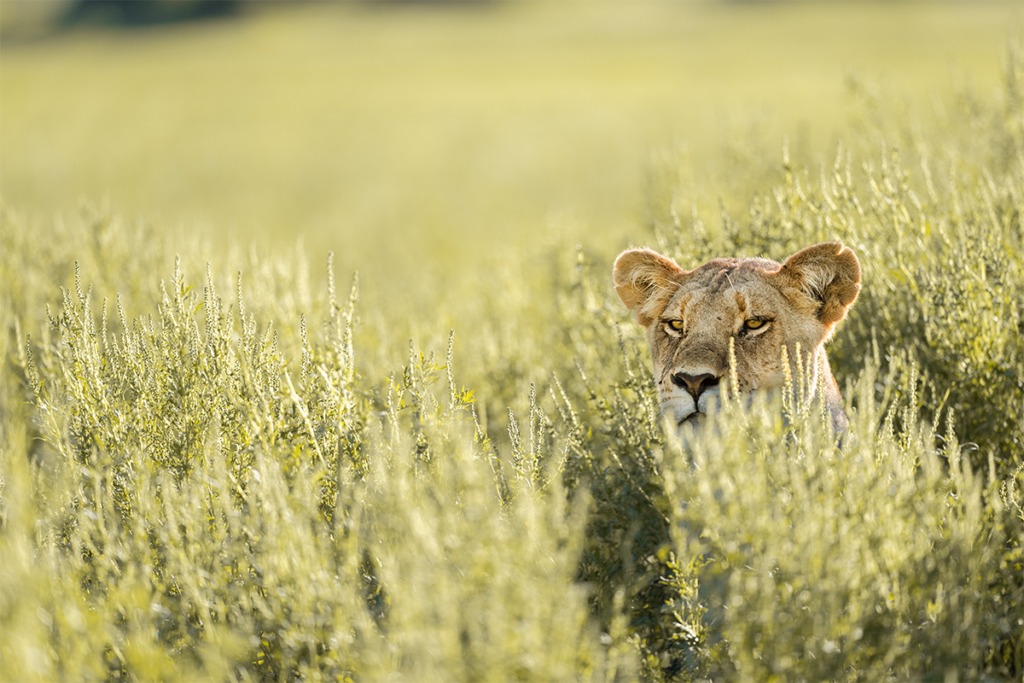
Olbarnoti the name means ‘the big one’ in Maa, the Maasai tongue has held territory in the southern section of Naboisho for several years. But the true measure of a lion is not in how he holds ground; it is in what he builds on it. On our third morning in the conservancy, Lemaiyan guided us to a shallow depression behind a stand of croton bush, where Olbarnoti’s two lionesses had settled with a litter of eight cubs, the youngest barely three weeks old.
Watching lion cubs is one of those experiences that recalibrates your sense of time. Nothing happens quickly. Everything happens perfectly. The cubs wrestled with their mothers’ tails, ambushed one another from behind termite mounds, and collapsed in exhausted, breathing heaps under the midday shade. Olbarnoti watched all of it from a distance close enough to respond, far enough to allow it. There is a particular kind of patience in the wild that we rarely give ourselves permission to practise. Sitting with this pride in the morning silence of Naboisho, we were reminded of it.
Lions face enormous pressure across Africa habitat encroachment, prey depletion, retaliatory killing. That a coalition like Olbarnoti’s can raise cubs successfully in Naboisho is not accidental. It is the direct result of the conservancy model: Maasai land, responsibly leased, lightly impacted, and carefully managed. The lions here are not an attraction. They are residents. And in that distinction lies everything.
Nashipai: A Cheetah Mother Against the Odds
If lions represent the raw, unhurried power of the savannah, cheetahs offer something more vulnerable: a beauty that feels almost borrowed, an elegance that exists under constant threat. The cheetah is Africa’s most endangered big cat, pressured not just by humans but by the larger predators with whom it shares every inch of territory. Nashipai, a female cheetah who has raised two successive litters within Naboisho, understands this intimately.
Her name, meaning ‘happy one,’ was given by the Maasai rangers who have tracked her movements for years. There is something quietly defiant about her story. As a single mother operating in a lion-dense landscape, Nashipai has had to master not just the art of the hunt but the art of survival: reading wind patterns, scanning termite mounds before she sprints, teaching her cubs not only to chase but to know when not to. On a golden afternoon in the open plains east of the Olare River, we watched her three sub-adult cubs practice hunting on a small herd of Thomson’s gazelle. The coordination between them flanking, cutting, anticipating was extraordinary for animals that were barely eight months old.
The hunt was unsuccessful, as many are. But Nashipai did not appear discouraged. She called her cubs together with a series of bird-like chirps and led them calmly to higher ground to scan for the next opportunity. Watching her, you are struck by the thought that perhaps persistence is its own kind of success.
Siri: The Leopard That the Conservancy Keeps Secret
No animal tests a naturalist’s patience or rewards it quite like the leopard. They are creatures that seem to enjoy being theoretical; their presence is felt through alarm calls and claw marks before it is ever confirmed by eyes. ‘Siri’ means ‘secret’ in Swahili, and it is a name that suits Naboisho’s most elusive resident with precision.
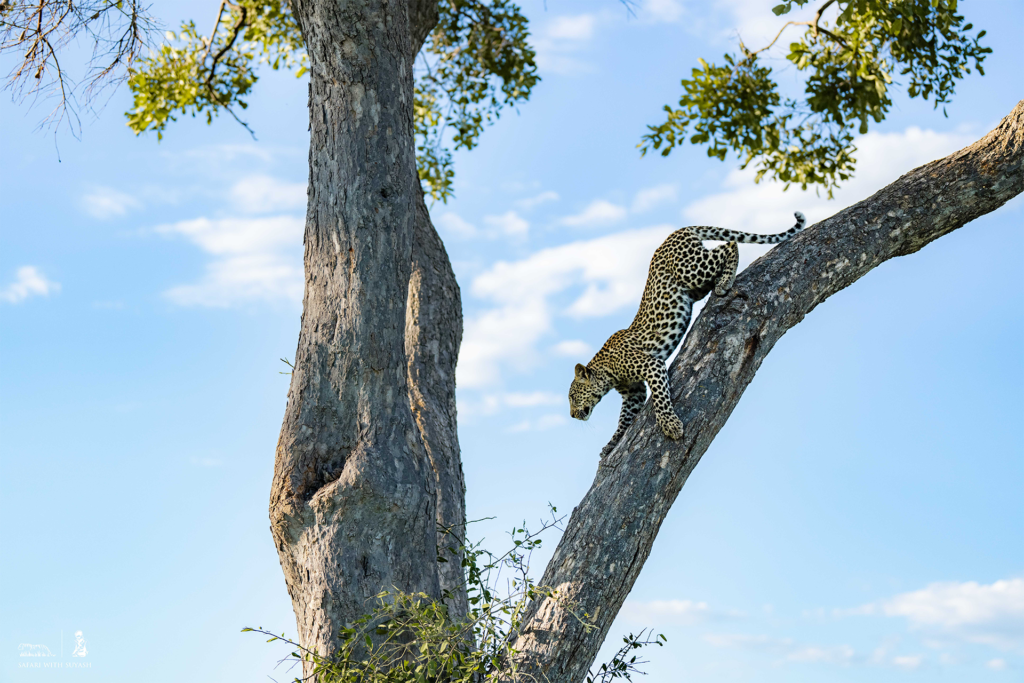
Lemaiyan had been tracking Siri’s movements for weeks before our arrival, piecing together her territory from pugmarks in dry riverbeds, tufts of impala hair caught on thorns, and the behaviour of superb starlings that suddenly scatter from a fig tree without obvious cause. On our fifth morning, following a trail of agitation through the bush, we finally found her stretched along a sausage tree branch, her spotted coat dissolving so completely into the dappled light that we almost drove past her.
She regarded us with the cool indifference that only leopards are capable of the gaze of an animal that has decided you are neither threat nor opportunity, and has therefore dismissed you entirely. Below her, a half-eaten impala was wedged securely in the fork of the trunk, untouchable by any scavenger from the ground. Siri yawned once, revealing a cave of white teeth, and went back to sleep. We held our breath for a long time after.
What the leopard teaches you, if you are willing to learn, is the value of presence over spectacle. Siri was not performing. She was simply being and the privilege of witnessing it was enormous precisely because it required something of us: patience, quietness, a willingness to let the wild be on its own terms.
Why Naboisho and Why It Matters
Not every corner of the Masai Mara ecosystem is equal. In the most visited areas, the game drives can feel less like a wildlife encounter and more like a traffic jam with a dozen vehicles converging on a single lion at first light. Naboisho is categorically different. With strict limits on the number of vehicles permitted in the conservancy and the bulk of land co-managed with local Maasai communities, it has deliberately chosen depth over volume.
This matters for the cats. Animals that are not habituated to crowds behave naturally. A cheetah that has not learned to associate vehicles with fifteen competing lenses moves as cheetahs are meant to move freely, purposefully, on her own schedule. The quality of wildlife encounters in Naboisho is not simply a product of luck. It is the product of a system that respects animals enough to give them room.
At Ameliya, we have long believed that the most meaningful safari is not the one with the most sightings, it is the one that leaves you changed. The kind of encounter that makes you understand, at something deeper than an intellectual level, why places like Naboisho must be protected. Suyash often says: what we can see, we can love. And what we can love, we will fight to protect. Olbarnoti, Nashipai, and Siri in their own inscrutable, magnificent ways are exactly the kind of reminder the world needs.
Naboisho is just one corner of Africa’s wildlife story. If you’re still building your safari wishlist, here’s our guide to the five animals that, in our experience, tend to change people — and where to find them